top of page

California FAIR Plan $3M Cap: Why Luxury Homes Need Wildfire Defense Systems (Ham Lake Fire Proof)
  • Writer: Shawn Gardner
    Shawn Gardner
  • 7 days ago
  • 8 min read

The solution that saved homes in the 2007 Ham Lake Fire still isn't standard in California's WUI


Article Summary

California's FAIR Plan caps coverage at $3 million, leaving luxury homeowners with massive uninsured gaps. Yet the 2007 Ham Lake Fire proved exterior sprinkler systems work—structures with systems survived while 140+ homes without them burned. Despite this evidence, California lacks certification standards to bridge proven technology and insurance recognition. This article examines why the solution that worked 17 years ago still isn't standard in the Bay Area's WUI.

ree

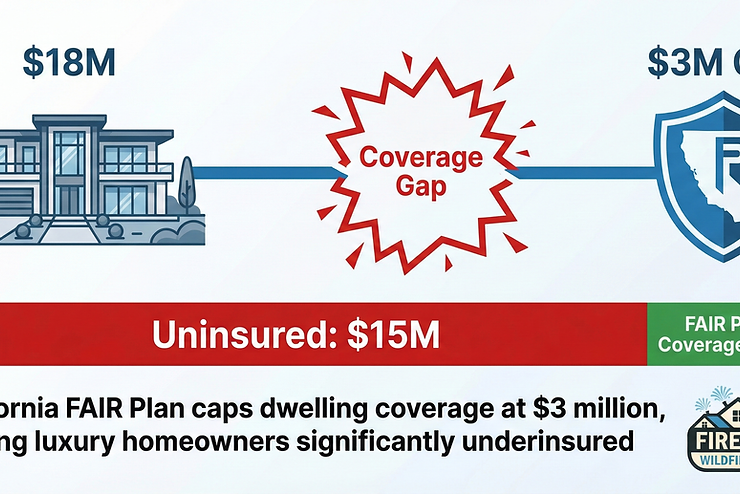
Last month, a client called me from Los Altos Hills. His home is valued at $18 million. His insurance company dropped him. FAIR Plan offered him $3 million in coverage.

"So I'm just supposed to accept that $15 million of my home is uninsurable?" he asked.

Yes. That's exactly what California expects you to accept.


But here's what nobody's telling you: The reason your home has inadequate coverage has almost nothing to do with whether it can actually survive a wildfire.

It has everything to do with the fact that your $10M-$20M home has the exact same fire defense as a suburban tract house: nothing.


ree

The California FAIR Plan Math: Why Your $10M Home Gets $3M Coverage

Insurance companies aren't stupid. They know something homeowners don't:

Between 60-90% of homes in California wildfires don't burn from flames.

They burn because an ember the size of a quarter lands on your roof at 2 AM on a Tuesday, and there's nothing there to stop it.

According to the California Office of the State Fire Marshal, embers are the most common cause of home ignition during wildfires. Your home has:

  • Smoke detectors (for fires that start inside)

  • Maybe a fire extinguisher (for fires you're home to fight)

  • Nothing for the ember that lands on your roof when you're evacuated

The insurance industry has done the math:

  • Home ignites from ember → $8M-$15M payout

  • Multiply by thousands of homes in the WUI

  • Risk becomes difficult to underwrite

So they drop you, or offer inadequate coverage through FAIR Plan's $3 million cap.


Here's The Part That Should Make You Angry

This problem was solved 17 years ago.

In 2007, the Ham Lake Fire in Minnesota burned 75,000 acres and destroyed more than 140 structures.

But over 100 homes had exterior sprinkler systems installed through FEMA grants.

Structures with functioning sprinkler systems survived. More than 100 homes without sprinklers burned to the ground.

According to reporting from the Duluth News Tribune and research from the University of Minnesota:

  • Sprinkler-equipped properties drew water from lakes

  • Systems wetted roofs, eaves, walls, and surrounding vegetation

  • Only one sprinkler-equipped structure burned, and it ignited from underneath (outside the sprinkler coverage area)

  • The Cook County Sheriff stated: "I wasn't sure if they would really save a structure in a real big fire. But we've seen in the last couple of days that they are incredibly effective."

The University of Minnesota's analysis concluded:

"The Ham Lake wildfire experience with the sprinkler systems as one component of wildfire preparedness demonstrated that the systems, when properly installed and maintained, can be extremely effective in protecting not only the built structure but also the trees and vegetation within the sprinkler area."

This isn't theory. This isn't marketing. This is documented in multiple official reports and academic studies.

The solution exists. It works. It's been proven in real wildfires.

So why doesn't your $15 million home have one?

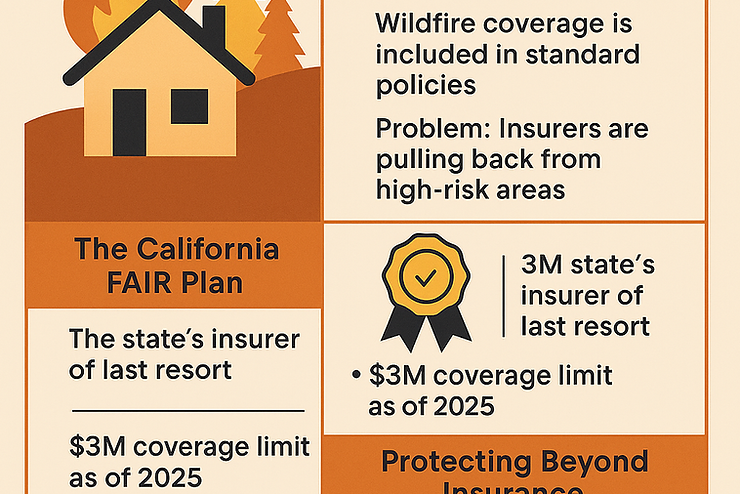
California FAIR Plan Coverage for Wildfire Coverage

Because The System Hasn't Caught Up

Here's the uncomfortable reality:

Exterior wildfire defense systems work. The insurance industry just hasn't figured out how to recognize them yet.

California has no certification standard for automated exterior suppression systems. Australia has AS 5414 (national standard for exterior spray systems). Canada has FireSmart verification protocols. California has... nothing comparable.

Without standardized testing and certification, insurers can't offer meaningful discounts. Without discounts, homeowners don't install systems. Without widespread adoption, California doesn't develop standards.

It's a system gap—and you're stuck in the middle with a $7M-$15M coverage shortfall.


What Actually Stops Ember Ignition

I've spent decades in fire mitigation and irrigation. Here's what the research actually shows:

The California Office of the State Fire Marshal reports that between 60-90% of home ignitions in wildfires are caused by embers.

Embers don't care that your home is worth $18M. They care about:

  • Is your roof dry?

  • Are your eaves dry?

  • Is there a half-inch gap in your vent screen?

A properly designed exterior sprinkler system addresses all of this:

  • Wets the roof before embers arrive

  • Keeps eaves and fascia from igniting

  • Creates a humidity barrier around the structure

  • Operates when you've evacuated and can't defend manually

The evidence isn't limited to Ham Lake:

Kelowna, British Columbia (2003): During the Okanagan Mountain Park Fire, nearly 200 homes with roof sprinklers survived while many neighboring homes without sprinklers were destroyed.

Australia: Multiple bushfire studies documented higher survival rates for homes with exterior water spray systems. Australia created AS 5414, a national engineering standard for these systems.

Tasmania: 2016-2020 studies showed higher survival rates for homes with roof and wall sprinklers in ember-driven wildfire conditions.

Class A Gel Deployments (California): During the Ranch Fire, Tubbs Fire, and Camp Fire, fire gel applied to homes helped prevent ignition under heavy ember exposure. CAL FIRE units deployed gel during structure protection operations.

Not 10% better. Not 30% better.

Dramatically higher survival rates when systems functioned properly.

Wildfire Home Losses due to Embers

The System Gap Nobody's Talking About

You're caught between two realities:

Reality 1: The technology exists and has proven effective in documented case studies.

Reality 2: The insurance industry hasn't created a framework to recognize it.

Why the gap?

1. No California certification standard

  • Australia has AS 5414 (national standard for exterior spray systems)

  • Canada has FireSmart verification protocols

  • California has... nothing comparable for automated suppression

  • Insurers can't offer discounts for something they can't verify

2. Legitimate reliability concerns

  • Will the system have water when city pressure fails?

  • Will it have power during grid outages?

  • Will it activate when the homeowner has evacuated?

  • Most DIY or contractor systems can't answer these questions

3. Limited actuarial data

  • Ham Lake was 2007 - one fire, one region

  • Insurance models need broader data sets

  • California hasn't tracked sprinkler-equipped home survival rates systematically

  • Without data, actuaries default to "high risk" for all WUI homes

4. The catastrophic loss problem

  • When ONE fire (Camp Fire: $12B, Tubbs: $9B) can devastate an insurer

  • And homes are concentrated in the same fire path

  • Traditional insurance models break down

  • It's not about YOUR home's risk - it's about 5,000 homes burning simultaneously

The result? Insurers retreat entirely rather than differentiate between defended and undefended homes.


What This Means For You

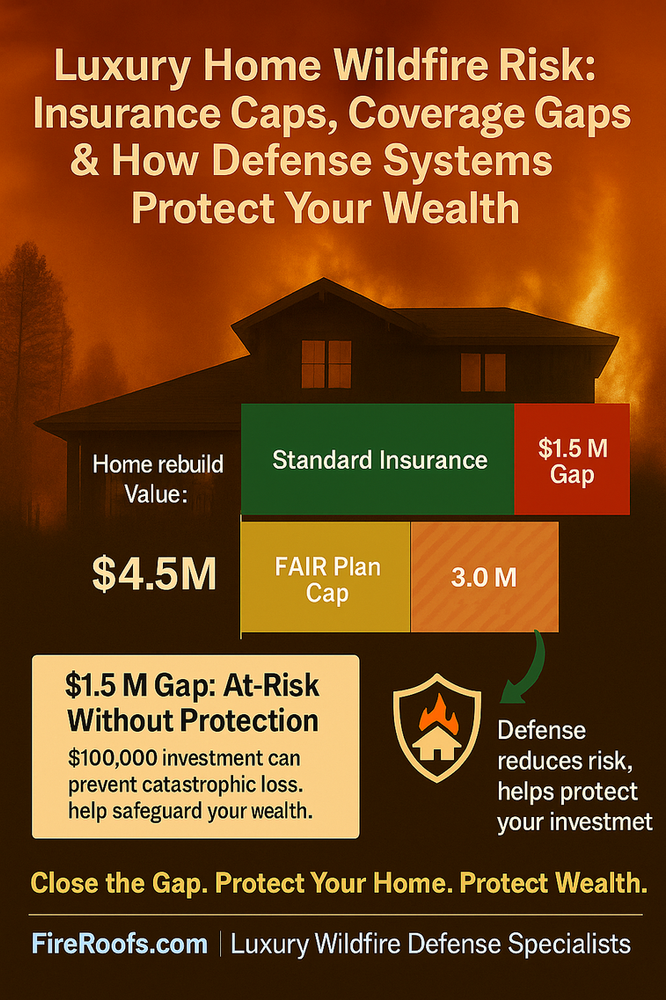
So you're paying high premiums for FAIR Plan coverage that caps at $3M on an $18M home - even though your home COULD be engineered to survive.

This isn't a conspiracy. It's a market failure.

The insurance industry is responding to real catastrophic risk. Climate change IS making wildfires worse. WUI development concentrates exposure. Catastrophic losses are real.

But they're using a blunt instrument (dropping all WUI policies or inadequate coverage) instead of differentiating between homes that burn easily and homes that are engineered to survive.


The Professional-Grade Difference

Not all exterior sprinkler systems are equal. The ones that fail usually fail for these reasons:

❌ Rely on city water (which fails during fires)

❌ Require manual activation (homeowner already evacuated)

❌ No backup power (grid fails in wildfires)

❌ Poor coverage (roof only, misses eaves and vents)

❌ No early warning (system activates too late)

The systems that worked in Ham Lake, Australia, and Canada had:

✅ Independent water source (lakes, tanks, pools)

✅ Automated activation (doesn't require homeowner presence)

✅ Backup power systems

✅ Full perimeter coverage (roof, eaves, fascia, walls)

✅ Early detection and alert systems


FireRoofs Wildfire Defense Systems are engineered specifically for these failure points:

  • Pool/tank integration: 10,000+ gallon backup when city water fails (because municipal water pressure drops to zero in major fires)

  • AI wildfire detection: Satellite alerts up to 7 miles radius, wildfire sensors monitoring property

  • Backup power: System operates during grid outages

  • Automated activation: IoT controllers with mobile app control - activate from anywhere during evacuation

  • Class A FireFoam: Extends protection time, resists heat better than water alone

  • Full perimeter coverage: Roof, eaves, fascia, walls, decks - every ember entry point

This isn't a garden sprinkler on a timer. It's an engineered suppression system built to the standards that worked in documented case studies.

We're not inventing new technology. We're professionalizing what already worked in Ham Lake, making it reliable for California luxury homes, and addressing the exact failure points that cause systems to fail when they're needed most.

Proof that exterior sprinklers protect from wildfires

The Bottom Line

California's insurance crisis is real. Climate change is making wildfires worse. WUI development concentrates risk. Catastrophic losses are challenging insurers.

All of that is true.

Also true: Homes with properly engineered exterior sprinkler suppression systems survive wildfires at dramatically higher rates than homes without them.

The gap is this: California hasn't built the certification framework to bridge proven technology and insurance recognition.

So you have two choices:

Wait for the system to catch up (which could take years, while your $7M-$15M coverage gap remains)

Or engineer your home to survive anyway - because protecting your family's uninsured equity is more important than waiting for State Farm to figure out their actuarial models.

Ham Lake homeowners didn't wait for insurance company approval.They installed systems, the fire came, and their homes survived.

Your $15M doesn't have to burn.

But someone has to decide to defend it.


Sources & Citations

All claims in this article are supported by official sources:

Ham Lake Fire (2007):

Ember Ignition Statistics:

FAIR Plan Coverage:

International Case Studies:

California Wildfire Data:

About the Author

Shawn Gardner is co-founder of FireRoofs and former Parks and Open Space Manager for the City of Saratoga, with 20+ years of experience in fire mitigation, irrigation design, and municipal infrastructure. His mission: to save homes and protect families' memories.


This article is based on documented case studies, official government sources, and peer-reviewed research. All claims are factually accurate as of December 2025. While exterior wildfire defense systems have proven effective in multiple real-world scenarios, no system can guarantee 100% protection against all wildfire conditions. Effectiveness depends on proper installation, maintenance, adequate water supply, and appropriate activation timing.


Comments

Rated 0 out of 5 stars.
No ratings yet

Add a rating
bottom of page