top of page

One Year Later: The Palisades and Eaton Fires, Water System Failures, and What WUI Homeowners Must Understand
  • Writer: Shawn Gardner
    Shawn Gardner
  • 5 days ago
  • 8 min read

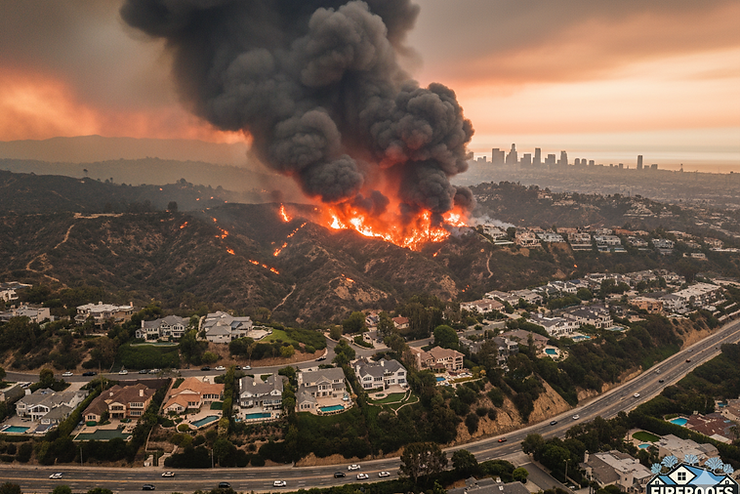
Palisades Fire smoke and flames over Los Angeles hillside homes January 2025 showing wildfire destruction scale


It's been exactly one year since January 7, 2025. That's the day two catastrophic wildfires erupted in Los Angeles County and changed how we think about wildfire defense in dense urban areas.


I remember that morning. Hurricane-force Santa Ana winds. Tinder-dry vegetation. Red flag warnings everywhere. By 10:30 a.m., the Palisades Fire started in the Santa Monica Mountains near Pacific Palisades. Just eight hours later at 6:18 p.m., the Eaton Fire ignited in Eaton Canyon near Altadena. Both fires exploded in size within minutes.


What happened over the next 24 days exposed critical gaps in how we protect homes in California's wildland-urban interface. The fires destroyed over 16,000 structures. Killed at least 31 people. Forced more than 200,000 to evacuate. And revealed that when things go wrong, they go wrong fast.


Here's what we learned, and why it matters for every homeowner living where wildfire threatens.


The First Hours: When Everything Escalated Simultaneously

The Palisades Fire started small. Ten acres at first. But wind gusts reached 100 mph in some areas that day. By 11:30 a.m., just one hour after ignition, the fire had grown to 200 acres.


Homeowners who called 911 within minutes of the fire starting reported getting busy signals. Some accounts suggest first firefighters didn't arrive for 45 minutes. By that time, embers were already raining down on neighborhoods miles from the original ignition point.

That evening, the Eaton Fire erupted near Altadena Drive. Residents next to the canyon told emergency services an electrical tower was on fire. Within 15 minutes, firefighters were reporting flying embers setting structures on fire nearly a mile away.


Between 60-90% of home ignitions in wildfires are caused by embers, not direct flame contact, according to the California Office of the State Fire Marshal. That's exactly what happened here. Embers drifted ahead of the fire fronts, landing on roofs, in gutters, near vents. Finding weak spots. Starting small fires that became structure fires.


Evacuation Orders: The Failures That Cost Lives

More than 200,000 people were placed under evacuation orders during the fires. But the timing of those orders, particularly for the Eaton Fire, became one of the most controversial aspects of the disaster.

West Altadena residents received mandatory evacuation orders at 3:00 a.m. on January 8, hours after residents in East Altadena. That delay proved deadly. Of the 19 confirmed deaths from the Eaton Fire, all but one lived west of Lake Avenue, the predominantly Black neighborhood that got late warnings.


An independent after-action report by the McChrystal Group highlighted "staffing shortages at the Los Angeles County Sheriff's Department and the county's Office of Emergency Management, as well as policies and protocols on evacuation warnings that were outdated, unclear and contradictory."

Video from that night shows residents of a Pasadena senior care home being evacuated in wheelchairs through thick smoke. Some evacuees reported learning about the fire from neighbors, not official warnings. Cell service was spotty. Power was already out in many areas.


When evacuation orders finally came for some neighborhoods, roads were already blocked by fallen trees, downed power lines, and abandoned vehicles.


The Water Crisis: What Actually Happened

Here's where things got complicated and controversial.

 Firefighter testing municipal fire hydrant water pressure showing limitations of city water systems during wildfires

Around 6:30 p.m. on January 7, firefighters first reported low hydrant pressure in Pacific Palisades. By the next day, Los Angeles city crews had stopped drawing from hydrants entirely in some areas. According to the Los Angeles Department of Water and Power, demand surged to four times higher than any previously recorded levels in the system.

The Santa Ynez Reservoir became the focal point of public outrage. This 117-million-gallon reservoir sits directly above Pacific Palisades. It was empty during the fires, offline since January 2024 for repairs to its floating cover.


Governor Gavin Newsom ordered an investigation. People wanted to know: would a full reservoir have saved homes?


The state investigation released in November 2025 concluded something surprising. Even if the Santa Ynez Reservoir had been full, it would have added only about 15% to the water flow, providing a maximum supplemental flow of 5,500 gallons per minute. The system was already pumping 37,000 gallons per minute to the fire area.


"The water system lost pressure, not due to a lack of water supply in the system, but because of an insufficient flow rate," the report states.


What overwhelmed the system wasn't lack of water. It was unprecedented demand from hundreds of simultaneously burning structures, plus massive leakage from destroyed buildings where pipes burst and water flowed freely into the ground.


Municipal water systems are designed to fight house fires. One or two at a time. They're not designed to supply water when entire neighborhoods burn simultaneously.


Why Municipal Water Fails in Major Wildfires

Here's the thing most people don't realize about city water during catastrophic fires.


The system depends on pressure. When demand suddenly spikes across a wide area, pressure drops. Fast. In higher elevations like Pacific Palisades, approximately 20% of fire hydrants failed as the three 1-million-gallon local tanks ran dry within hours.

It's not unique to Los Angeles. The same pattern happened in the 2017 Tubbs Fire in Santa Rosa, the 2018 Camp Fire in Paradise, the 2021 Marshall Fire in Colorado, and the 2023 Lahaina blaze in Maui. When multiple neighborhoods burn at once, municipal water systems struggle or fail.


The UL Research Institutes' 350-page timeline report noted that "damaged or destroyed water distribution systems, with water spewing freely from pipes, drained water supplies and diminished fire hydrant pressure."


Aerial firefighting teams resorted to using ocean water, despite the contamination risks salt water poses to ecosystems. That's how desperate the water shortage became.


From my 20 years in fire mitigation and municipal public works, I can tell you this isn't a new problem. It's just that most communities haven't faced fires this intense over such a large area before. Climate change is making these events more frequent. The 2025 fires proved what many of us have known: when it matters most, you can't count on city water.


What Survived: The Evidence for Independent Systems

Here's what gets overlooked in all the controversy about municipal water.


Some homes survived when everything around them burned. Not by luck. Through independent wildfire defense systems that didn't rely on city water pressure.

Frontline Wildfire Defense, one of the national providers, documented 96% survival rates on 61 protected homes in the Palisades and Eaton fire zones. Developer Rick Caruso used private firefighting teams with independent water sources to save multiple structures in the Palisades Village area.


The pattern isn't new. The 2007 Ham Lake Fire showed that structures with functioning sprinkler systems tied to independent water sources survived when city water failed. More than 140 structures were destroyed in that fire, but homes with systems that didn't rely on municipal pressure made it through.


Australia has had a national standard for exterior spray systems since the 2009 Black Saturday fires. The difference there? They recognized early that municipal water couldn't be relied upon during major wildfire events. Their AS 5414 standard requires independent water storage.


The Pool and Tank Backup Solution

This is where FireRoofs and other automated wildfire defense systems differ from traditional approaches.

Every system we install integrates with at least 10,000 gallons of independent water storage. Usually that's a pool. Sometimes it's a dedicated water tank. The point is, when city pressure drops to zero, the system keeps running.

Automated wildfire defense system connected to luxury home pool providing independent water backup for ember protection

The 2025 LA fires proved why this matters. Municipal water failed in the first hours. But homes with independent water sources and automated activation could defend themselves even after evacuation orders forced residents to leave.


It's not simple. The system needs proper pump capacity, filtration to handle pool or tank water, zone-specific coverage design, and fail-safes for power outages. But it addresses the documented failure point that municipal water exposed.


Some people ask why this isn't standard. Here's the reality: California has no certification standard for exterior wildfire defense systems. Unlike Australia's AS 5414, there's no framework for insurers to verify systems or offer premium discounts. It's a market failure, not a technology problem.


The 2025 California Fire Code moves toward stronger ember-resistant construction requirements. Zone Zero requirements by 2029 will mandate 0-5 foot clearance around structures. Home hardening disclosure is now required for pre-2010 homes in high-risk zones. That's progress.


But for existing luxury homes in places like Los Altos Hills, Saratoga, or Woodside, passive measures alone don't provide active defense when you're evacuated and embers are landing on your roof.


Are People in the WUI Safer Today?

Here's what changed in the year since the Palisades and Eaton fires.


Los Angeles County has launched independent investigations into evacuation delays. The LAFD released an after-action report in October 2025 acknowledging they didn't keep staff from previous shifts to help in initial fire response due to budget constraints. That's changing. "All staff will be immediately recalled and all available apparatus staffed, regardless of external factors or financial impact," the report states.


Evacuation protocols are being revised. The county is updating policies to clarify roles and responsibilities for first responders and emergency management during wildfire events.


Southern California Edison is undergrounding 153 circuit miles in burn scar areas. Federal authorities charged a Florida man with arson for allegedly setting the January 1 fire that reignited as the Palisades Fire.

The LAFD now monitors burn scar areas with heat-detecting drones. After firefighters left the scene of the Lachman Fire on January 2 while it continued smoldering underground, only to have it reignite as the devastating Palisades Fire five days later, thermal monitoring became non-negotiable.


But here's what hasn't changed: municipal water systems still aren't designed to fight wildfires over large areas. The California FAIR Plan still caps dwelling coverage at $3 million, leaving Bay Area luxury estates massively underinsured. Climate conditions continue making fires more frequent and intense.


A Berkeley study released in 2025 showed that home hardening plus defensible space reduces destruction by 50%. That's real progress. But it assumes you can maintain defensible space on steep slopes, that embers don't find entry points through vents or valleys, and that someone is home to respond.


The Reality Check: What Protection Actually Looks Like

None of this guarantees a home will survive. Let me be clear about that.


The 2025 fires burned in extreme conditions. 100 mph winds. Single-digit humidity. Drought-stressed vegetation after years of atmospheric rivers that grew massive fuel loads. In those conditions, even perfect preparation sometimes isn't enough.


But the data shows that independent automated wildfire defense systems with proper water backup shift the odds significantly. The difference between a 4% loss rate and a much higher one matters when it's your home.


For luxury estates in the Bay Area worth $5 million to $20 million, the insurance coverage gap makes this personal. When your FAIR Plan coverage caps at $3 million, that leaves $2 million to $17 million of your property essentially uninsured. Traditional insurance markets continue pulling out of high-risk WUI zones.

That's why we focus on Bay Area properties within our 50-mile service radius from San Jose. Because luxury estates need custom engineering, not volume-based approaches. Because local expertise matters when designing systems for specific properties in communities like Los Gatos, Portola Valley, or Scotts Valley.

FireRoofs wildfire defense system connected  pool providing independent water backup for ember protection

What the Palisades and Eaton Fires Taught Us

One year later, here's what stands out from January 7, 2025.

Embers cause most home losses, not flames. Evacuation orders come too late sometimes, or communication systems fail. Municipal water pressure drops when you need it most. Independent backup water is critical. Automated systems that work without human intervention can protect homes during evacuation. And climate conditions are making extreme fire weather more frequent, not less.


People living in California's wildland-urban interface face a choice. Accept the risk and hope for the best. Or engineer solutions that address documented failure points.

We can't control the weather. We can't guarantee outcomes. But we can build systems that give properties the best chance when the worst happens.


If you're a homeowner in the Bay Area's WUI zones, the question isn't whether another major fire will happen. Fire scientists agree it's when, not if. The question is what active defense exists at your property when evacuation orders come and you have minutes to leave.


The Palisades and Eaton fires showed us the gaps in traditional approaches. Independent water sources. Automated detection and activation. Coverage designed for ember defense, not just flame contact. These aren't theoretical requirements anymore. They're lessons written in the ashes of 16,000 destroyed structures.

One year later, some homeowners understand this. Others are still waiting for someone else to solve the problem. The fires taught us that when crisis hits, you're on your own sooner than you think. The homes that survived had systems in place before evacuation orders came.


Ready to learn how automated wildfire defense with independent water backup can protect your property? Schedule a free property evaluation to see what protection looks like for your estate.


While exterior wildfire defense systems have proven effective in multiple real-world scenarios, no system can guarantee 100% protection against all wildfire conditions. Effectiveness depends on proper installation, maintenance, adequate water supply, and appropriate activation timing.


bottom of page