
The Complete Guide to Water Storage Tanks for Wildfire Defense in California
- Shawn Gardner
- Nov 17, 2025
- 19 min read
If you live in a California wildfire zone, you've probably asked yourself: "What happens if the water shuts off during a fire?" It's a question that keeps many homeowners up at night, and for good reason. When wildfires threaten your property, having an independent water supply isn't just smart planning. It's potentially the difference between losing everything and saving your home.

FireRoofs Wildfire Defense Systems, brings years of specialized experience to California homeowners in high-risk areas. We have successfully installed countless exterior sprinkler systems across the Santa Cruz Mountains, Saratoga, Los Gatos, and the broader South Bay Area of California. This extensive, real-world work has given us unparalleled expertise in developing effective wildfire defense strategies, especially when it comes to the critical challenge of water storage
Research Sources and Standards
This guide draws from authoritative sources and industry standards:
Fire Protection Standards:
NFPA 22: Standard for Water Tanks for Private Fire Protection - National Fire Protection Association guidelines for fire protection water storage
NFPA 1142: Standard on Water Supplies for Suburban and Rural Fire Fighting - Requirements for water supply systems in wildfire-prone areas
California Fire Resources:
CalFire: Prepare for Wildfire - California Department of Forestry and Fire Protection official wildfire preparedness guide
CalFire: Fire Hazard Severity Zone Maps - Official fire risk classifications for California properties
Water Storage Industry Resources:
American Water Works Association (AWWA) - Water storage system standards and best practices
California Building Standards Commission - State requirements for water storage installations
Wildfire Research:
Insurance Institute for Business & Home Safety (IBHS) - Wildfire home protection research and testing
UC Berkeley Fire Research - Academic research on wildfire behavior and home survival
Why Water Storage Matters for Wildfire Protection
During major wildfires, municipal water systems often fail when you need them most. Power outages disable pumps, infrastructure burns, and water pressure drops to nothing as firefighters draw from hydrants across affected areas. Your home's exterior sprinkler system is only as reliable as your water supply.
That's where dedicated water storage tanks come in. A properly sized tank gives your FireRoofs system the independence it needs to keep protecting your home even when city water fails.
How Long Will Water Last in a Storage Tank During a Wildfire?
This is the number one question we hear, and the answer is straightforward once you understand the math. Your water source determines everything.
The Reality of Water Consumption
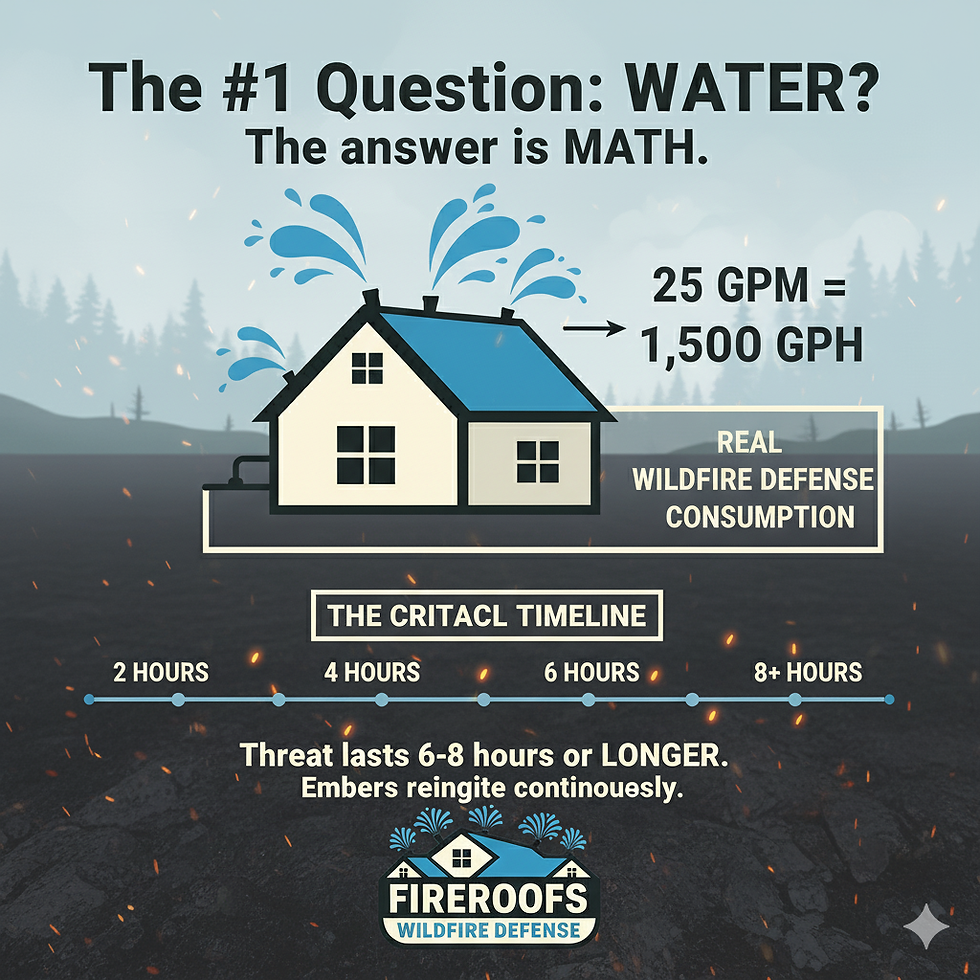
A professional FireRoofs system drawing 25 gallons per minute (gpm) consumes 1,500 gallons per hour (GPH). This isn't a system running at half capacity. This is what real wildfire defense requires.
The Critical Timeline Most wildfires don't just pass in 2-4 hours. The ember attack window (the period when your home faces the greatest threat) typically lasts 6-8 hours or longer in severe fires. Flying embers can land on your property hours after the main fire front passes, reigniting threats continuously.
Minimum Storage Requirements
Based on these realities, here's what you actually need:
With a Well Water System: 5,000 Gallons Minimum
25 gpm × 60 minutes = 1,500 gallons per hour
1,500 GPH × 6 hours = 9,000 gallons needed
With cycling: 5,000 gallons provides adequate protection
Your well provides continuous refill during operation
With Municipal Water: 10,000 Gallons Minimum
Municipal water during a wildfire event? That fails.
Power outages disable pumps
Firefighters drain hydrants across the area
Infrastructure burns, water pressure drops to zero
You need complete water independence: 10,000 gallons
Real-World Example: Understanding the Math
Let's calculate for the critical 6-hour ember attack window:
System demand: 25 gpm
Hourly consumption: 1,500 gallons (25 gpm × 60 minutes)
6-hour requirement: 9,000 gallons (1,500 GPH × 6 hours)
With a 5,000-gallon tank and well backup:
Tank provides: 3.3 hours of operation (5,000 ÷ 1,500)
Well refills continuously during operation
Combined system handles 6-8 hour events
With a 10,000-gallon tank (municipal water only):
Tank provides: 6.7 hours of operation (10,000 ÷ 1,500)
No municipal backup available during fires
Complete independence during critical period
Can You Use Your Pool?
Yes, and it's a surprisingly effective solution. A standard 18,000-gallon pool provides about 12 hours of continuous operation at 25 gpm. This works as a reliable backup or even primary water source if properly integrated with your FireRoofs system.
Pool as Water Source:
18,000 gallons ÷ 1,500 GPH = 12 hours of protection
Requires proper pump and filtration integration
Pool chemistry considerations for sprinkler components
Excellent option for properties with existing pools
Is There a Residential Water Storage Tank Specifically for Fire Suppression?
Yes, and it's crucial to understand the difference between general water storage and fire-rated systems.
NFPA 22 Compliant Tanks
The NFPA 22 (National Fire Protection Association Standard 22) establishes requirements for water tanks used in private fire protection. While NFPA 22 compliance is typically required for commercial fire suppression systems, understanding these standards helps you choose a better residential tank.
What NFPA 22 Standards Cover:
Tank structural integrity and materials
Foundation requirements
Seismic and wind load resistance
Pipe connections and fittings
Freeze protection in cold climates
Water quality maintenance
Inspection and testing protocols
For California Homes: Most residential wildfire defense systems, including FireRoofs exterior sprinklers, don't legally require NFPA 22 certified tanks. However, following these guidelines ensures your tank performs reliably during an emergency.
Key Features of Fire Protection Water Tanks
Whether NFPA 22 certified or not, your wildfire defense tank should include:
1. Adequate Outlet Size FireRoofs systems require 1.5" to 2" outlets to maintain proper flow rates. Undersized connections create bottlenecks that reduce system effectiveness.
2. Reliable Fill System Your tank needs automatic refilling from city water when available, plus manual fill options for water delivery trucks during extended emergencies.
3. Overflow Protection Prevents tank overfilling and water waste. Also provides important drainage during heavy rains.
4. Sediment Management Settling tanks or filtration prevents debris from clogging sprinkler nozzles. This is especially important if you're using well water or if your tank sits unused for months.
5. Pressure System Integration Most residential tanks require a booster pump to provide the 40-60 PSI needed for proper sprinkler operation. Your pump must be rated for continuous duty and have generator backup capability.
What Is the Best Tank for Underground Water Storage?
Underground tanks offer several advantages for California wildfire defense, though they come with unique considerations.
Advantages of Underground Storage
Fire Resistance Underground tanks are inherently protected from radiant heat and flame impingement, critical when wildfire conditions are most severe. Above-ground plastic tanks can melt or deform in intense heat.
Space Efficiency No surface footprint means more usable yard space. This matters significantly on smaller California lots where every square foot counts.
Temperature Stability Underground tanks maintain more consistent water temperature, reducing algae growth and preventing freeze damage in higher elevations like the Santa Cruz Mountains.
Aesthetic Appeal Invisible water storage doesn't impact your property's appearance or views, important in California's scenic fire-prone areas.
Best Underground Tank Options
1. Concrete Tanks (2,000-5,000+ gallons)
Pros:
Extremely durable and fire-resistant
Can be driven over when properly installed
Minimal long-term maintenance
Excellent for large capacity needs
Custom sizing available
Cons:
Most expensive option ($8,000-$20,000+ installed)
Requires heavy equipment and significant excavation
Difficult to relocate if you move
May require structural engineer approval on hillside properties
Best for: New construction, major property improvements, or permanent installations where budget allows.
2. Fiberglass Tanks (1,200-5,000 gallons)
Pros:
Lightweight and easier to install than concrete
Naturally corrosion-resistant
Good structural strength
Moderate cost ($3,000-$10,000 installed)
Won't rust or deteriorate underground
Cons:
Can float in high water table areas (requires ballasting)
May need concrete pad or anchor system
Susceptible to crushing without proper backfill
Best for: Existing homes with good soil conditions, moderate budgets, and professional installation available.
3. Polyethylene (Plastic) Tanks (1,000-2,500 gallons)
Pros:
Most affordable option ($1,500-$5,000 installed)
Easy to transport and install
Completely corrosion-proof
Good for tight access situations
Cons:
Less durable than concrete or fiberglass
Maximum depth limitations
Not drivable (requires traffic-rated vaults if access needed)
Can deform under soil pressure if not backfilled properly
May degrade from UV exposure if any part remains above grade
Best for: Budget-conscious installations, remote access areas, or temporary solutions.
Critical Underground Installation Considerations
Soil Analysis California's varied geology requires site-specific planning. Clay soils expand when wet, sandy soils may not support tank sidewalls, and rocky soils increase excavation costs. Always have soil conditions evaluated before selecting your tank type.
Water Table Depth In areas with high seasonal water tables (common in some Bay Area locations), underground tanks can float out of the ground during wet winters. Proper ballasting and anchoring systems are essential.
Access for Maintenance Every underground tank needs accessible inspection ports and cleanout points. Plan for future maintenance - you'll need to inspect and potentially clean your tank every 2-5 years.
Permit Requirements Most California counties require permits for underground tank installation. Santa Cruz, San Mateo, and Santa Clara counties have specific regulations about setbacks from property lines, septic systems, and structures. Check your local requirements through the California Building Standards Commission or your county building department.
Above-Ground Tank Options: When They Make Sense
While underground storage offers advantages, above-ground tanks are often more practical for retrofit installations or budget-constrained projects.
Advantages of Above-Ground Storage
Lower installation cost (save $2,000-$5,000 on excavation)
Easier maintenance access for inspections and cleaning
Simple relocation if you need to move the tank
No water table concerns or floating risk
Faster installation (typically 1 day vs. 1 week)
Best Above-Ground Tank Types
1. Corrugated Steel Tanks (Pioneer Water Tanks, Aquamate)
Capacities: 1,000-10,000+ gallons
Extremely durable and fire-resistant
Proven performance in wildfire conditions
Cost: $2,000-$8,000 depending on size
Best for: Large capacity needs, longevity
2. Poly Tanks (Norwesco, Chem-Tainer)
Capacities: 500-5,000 gallons
Lightweight and affordable
UV-resistant formulations available
Cost: $800-$4,000
Best for: Budget installations, temporary systems
3. Modular Sectional Tanks (Aqua Armor)
Can be assembled in tight spaces
Fit through standard doorways
Good for difficult access properties
Cost: $1,500-$6,000
Best for: Narrow access, hillside properties
Protecting Above-Ground Tanks from Wildfire
The main concern with above-ground tanks during wildfires is heat exposure. Protect your investment:
Location: Place tanks on the non-fire-exposure side of your home (typically north or away from prevailing fire approaches)
Clearance: Maintain 30+ feet of defensible space around the tank
Insulation: Add thermal barriers or covers to metal tanks
Sprinkler Protection: Some homeowners add dedicated sprinklers to cool the tank itself during fires
Shading: Strategic planting or structures can reduce sun heating (but ensure plantings don't become fuel)
Recommended Tank Sizes for California Wildfire Defense
Based on our years of experience installing FireRoofs systems throughout California's fire zones, and understanding that professional systems consume 1,500 gallons per hour at 25 gpm, here are our sizing recommendations:
Properties with Well Water
Any Size Home with Well Backup Minimum: 5,000 gallons Recommended: 7,500 gallons Protection Duration: 6-8+ hours with continuous well refill
The well provides ongoing water supply during operation, so the tank serves as your immediate reserve while the well keeps pace with demand. This combination provides reliable protection through the critical ember attack window.
Properties on Municipal Water Only
Small to Medium Homes (Under 2,500 sq ft) Minimum: 10,000 gallons Recommended: 12,000-15,000 gallons Protection Duration: 6.7-10 hours
Large Homes (2,500-4,000 sq ft) Minimum: 10,000 gallons Recommended: 15,000-20,000 gallons Protection Duration: 10-13+ hours
Estates & Multi-Structure Properties (4,000+ sq ft) Minimum: 15,000 gallons Recommended: 20,000-30,000+ gallons Protection Duration: 13-20+ hours
Why Municipal Water Requires More Storage
Municipal water during a wildfire event fails. Here's why you need complete independence:
Power outages disable municipal pumps across entire regions
Firefighting demand drains hydrants and tanks, dropping pressure to zero
Infrastructure damage from fire destroys water mains and pumping stations
Widespread failures mean no backup when you need it most
You cannot count on city water during the emergency. Your tank must provide 100% of your water needs for the entire 6-8 hour ember attack window.
Properties with Pools
With 18,000-Gallon Pool a 3000 sqft home would be protected for 12 hours
The pool serves as your primary reservoir, with the dedicated tank as immediate supply and backup. This combination provides exceptional protection and is often the most cost-effective solution for properties that already have pools.
Factors That Increase Water Requirements
Extreme fire risk areas (CalFire Very High Fire Hazard Severity Zones), consider 20,000+ gallons
Remote locations with limited fire department access need extended protection
Multiple structures requiring protection (main house, guest house, barns) may require multiple systems
Dense surrounding vegetation that increases fire intensity and duration
Limited road access that slows emergency response, plan for 8-12 hour protection
History of extended ember attacks in your area, upgrade to maximum capacity
Working with Local Water Tank Specialists
At FireRoofs, we don't install water tanks ourselves. We partner with specialists who do this work daily. Here's why this approach serves you better:
Expertise in Local Regulations Water tank installation in California involves permits, setback requirements, and sometimes environmental reviews. Local specialists navigate these requirements efficiently.
Site-Specific Engineering Every property is unique. Soil conditions, slopes, access, and placement all require professional evaluation. Tank specialists bring this expertise.
Proper Installation is Critical Improperly installed tanks can float, collapse, crack, or fail when you need them most. Professional installation ensures reliability.
Warranty and Support Reputable tank companies stand behind their work with warranties and ongoing maintenance support.
Recommended Water Tank Specialists in California Fire Country
Santa Cruz Mountains / Los Gatos Area:
Santa Cruz Tank (831-423-8265): Specializes in large capacity tanks and underground installations. Excellent reputation for hillside properties.
Pioneer Water Tanks (800-547-8989): Corrugated steel tanks, known for durability in wildfire areas. Available throughout Northern California.
Advanced Water Tank Solutions (408-842-7000): Full-service from consultation through installation. Strong in the Los Gatos/South Bay area.
Broader Northern California:
Western Water Structures: Commercial and residential, all tank types
Aquamatic Systems: Specializes in fire protection water supplies
Bay Area Tank Company: Focus on underground installations
Southern California:
CST Storage: Statewide service, all tank types
SoCal Tank Company: Specializes in wildfire defense systems
National Suppliers with California Presence:
Snyder Industries: Poly tanks, nationwide distribution
Containment Solutions: Fiberglass and steel tanks
Modutank: Modular bolted steel tanks
Always get 2-3 quotes and verify licensing, insurance, and references before hiring any contractor.
Integrating Your Water Tank with Your FireRoofs System
Once your tank is installed, we handle the integration with your exterior sprinkler system. Here's what that involves:

1. Pump System Setup
Your tank needs a pump to deliver water at the right pressure. We specify and install:
Booster pump (typically 1-2 HP) sized for your system's flow requirements
Pressure tank to reduce pump cycling and extend equipment life
Pressure switch calibrated for optimal performance
Generator transfer switch for backup power capability
2. Controller Programming
This is where the magic happens. Our smart controllers maximize your water storage effectiveness:
Zone cycling to distribute water efficiently across your property
Soak periods that let water penetrate rather than run off
Priority zones to protect most vulnerable areas first
Tank level monitoring to prevent pump damage from low water
Automatic switching between city water and tank supply
3. Maintenance Protocols
We establish a maintenance schedule to keep your system reliable:
Annual system testing to verify all components work properly
Tank inspection for sediment buildup or damage
Pump servicing to ensure reliable operation
Sprinkler head cleaning and adjustment
Controller updates and programming review
Filling and Maintaining Your Water Storage Tank
Having a tank is only useful if it's full when you need it. Here's how to manage your water supply:
Automatic Fill Systems
Most tanks connect to your home's municipal water supply with an automatic fill valve (similar to a toilet tank). This keeps your tank topped off continuously without any effort on your part.
Components needed:
Float valve or electronic water level controller
Backflow prevention device (required by code, see AWWA standards)
Fill pipe with adequate diameter (3/4" minimum)
Overflow discharge (directed to appropriate drainage)
Manual Fill Options
In remote areas without city water, or as backup during municipal supply failures:
Water Delivery Commercial water delivery companies can fill your tank. Typical costs: $200-$400 per 3,000 gallons depending on location and distance.
Rainwater Harvesting California increasingly allows rainwater harvesting for fire protection. A 2,000 sq ft roof can collect 1,200 gallons from just one inch of rain. Consider:
Gutters and downspouts directed to your tank
First-flush diverters to keep debris out
Screening to prevent mosquito breeding
Well Water If you have a well, adding a fill line to your tank provides true water independence. Ensure your well pump has backup power.
Water Quality Management
Stored water can develop problems over time:
Algae Growth Prevent with:
Opaque tanks (blocks sunlight)
Tank covers
Periodic bleach treatment (1 cup per 1,000 gallons annually)
Sediment Accumulation Manage by:
Installing sediment filters
Regular tank flushing (every 2-3 years)
Bottom drain for cleanout
Freeze Protection At higher elevations in California's mountains:
Insulate pipes and above-ground tank portions
Use heat trace tape on exposed lines
Bury below frost line (usually 12-18" in California)
Costs: What to Budget for Your Water Storage System
Understanding costs helps you plan appropriately. Here's what to expect in California for properly sized wildfire defense systems:
Tank Purchase and Installation
Underground Tanks (Preferred for Large Capacity):
5,000-gallon concrete: $15,000-$25,000 installed
10,000-gallon concrete: $25,000-$40,000 installed
15,000-gallon concrete: $35,000-$55,000 installed
20,000-gallon concrete: $45,000-$70,000 installed
Above-Ground Tanks:
5,000-gallon steel: $8,000-$12,000 installed
10,000-gallon steel: $15,000-$22,000 installed
15,000-gallon modular: $20,000-$30,000 installed
20,000-gallon steel: $28,000-$40,000 installed
Pool Integration Systems:
Pump and filtration system: $5,000-$8,000
Plumbing and connections: $2,000-$4,000
Controls and automation: $1,500-$3,000
Total pool integration: $8,500-$15,000
Additional System Components
Pump system: $2,500-$5,000 (high-capacity pump, pressure tank, controls for 25 gpm operation)
Electrical work: $1,500-$3,500 (dedicated circuit, transfer switch, backup power integration)
Plumbing connections: $1,000-$3,000 (fill line, overflow, connections, backflow prevention)
Permits and inspection: $500-$1,500
Site preparation: $1,000-$5,000 (depends on access, excavation, and terrain)
Total Project Investment
For a complete water storage system integrated with FireRoofs exterior sprinklers:
Well Water Properties:
5,000-gallon system: $20,000-$32,000
7,500-gallon system: $25,000-$40,000
10,000-gallon system: $30,000-$50,000
Municipal Water Properties:
10,000-gallon system: $30,000-$50,000
15,000-gallon system: $40,000-$65,000
20,000-gallon system: $50,000-$80,000
Large estate system (30,000+ gallon): $70,000-$120,000+
Pool Integration Systems:
Existing pool conversion: $15,000-$25,000
New pool + fire system: $80,000-$150,000+ (includes pool construction)
Financing and Incentives
California Fire Safe Grants Some counties offer cost-share programs for wildfire hardening improvements. Check with your local Fire Safe Council or the California Fire Safe Council for available programs.
Insurance Premium Reductions Some California insurers offer discounts for homes with wildfire defense systems. The Insurance Institute for Business & Home Safety (IBHS) provides documentation on effective wildfire mitigation. Document your improvements and contact your agent.
Tax Benefits Consult with a tax professional about potential deductions for fire protection improvements.
Common Mistakes to Avoid
Through years of installations, we've seen these recurring problems that can leave homeowners unprotected:
Undersizing the Tank
This is the most dangerous mistake. Companies that recommend 1,200-2,500 gallon tanks are either using ineffective low-flow systems or misleading customers about water requirements. At 25 gpm (1,500 GPH), a 2,500-gallon tank provides less than 2 hours of operation, nowhere near the 6-8 hour ember attack window. Don't cut corners on capacity. During actual wildfires, you'll wish you had more water, never less.
Trusting Municipal Water
"We'll just use city water as backup." This thinking gets homes burned. Municipal water fails during wildfires, every single time in major events. Power outages, firefighting demand, and infrastructure damage mean you're on your own. If you're on municipal water, plan for 10,000+ gallons with zero backup expectations.
Undersizing the Pump
Your pump must deliver 30+ GPM at proper pressure for professional systems. Cheap 1 HP pumps rated for "light duty" will fail during extended operation. Invest in commercial-grade equipment rated for continuous duty. A $1,500 pump that burns out in hour 4 of an 8-hour ember attack is worthless.
Inadequate Backup Power
Your 10,000-gallon tank is useless if the pump can't run during power outages, which happen in 100% of nearby wildfire events. Plan for generator or solar backup from day one. A proper backup system costs $3,000-$8,000 but makes your entire investment functional.
Forgetting Maintenance on Large Systems
Large tanks require professional maintenance. Set calendar reminders for:
Monthly: Visual inspection and water level verification
Quarterly: Full system test including pump performance
Annually: Professional service and cleaning
Every 3-5 years: Tank inspection and sediment removal
A neglected 10,000-gallon tank with a failed pump or sediment-clogged intake is a $50,000 lawn ornament.
Ignoring Local Regulations
Unpermitted installations create massive liability issues. When your $40,000 underground tank installation lacks proper permits, insurance can deny claims. Building departments can require removal. Always pull proper permits and work with licensed contractors who handle permitting.
Inaccessible Placement
Think about maintenance access, pump service, and potential tank replacement when choosing location. Large tanks require equipment access for cleaning and service. Don't bury or obstruct access. You'll need to service this system for decades.
Believing the "Cycling" Myth
Some companies claim smart controllers "stretch" water by cycling zones. Yes, cycling is more effective than constant operation. But the math still requires adequate storage. At 25 gpm, you're consuming 1,500 gallons per hour whether cycling or not for an average 2500sqft home. Don't let clever marketing convince you that 3,000 gallons will protect your home for 8 hours. The physics don't work.
Frequently Asked Questions
Q: Can I use my swimming pool as a water source? A: Absolutely, and it's one of the best solutions available. A standard 18,000-gallon pool provides about 12 hours of continuous operation at 25 gpm. Pool integration requires specialized pump systems and filtration to protect sprinkler components, but many of our most successful installations use pools as the primary water source. The chemistry concerns are manageable with proper system design.
Q: Why do I need such large tanks compared to what other companies recommend? A: Because we're honest about water consumption. A professional system drawing 25 gpm consumes 1,500 gallons per hour. Many companies underestimate flow rates to make systems appear cheaper. When wildfire threatens your home, undersized storage means your system runs dry during the critical ember attack window. We size systems for reality, not marketing.
Q: How often do I need to refill my tank? A: With automatic fill systems connected to city water or well, your tank stays full continuously. Without automation, check levels monthly and maintain at least 90% capacity. Large tanks (10,000+ gallons) should be inspected quarterly to ensure they're at full capacity when needed.
Q: What's the difference between well water and municipal water sizing? A: Wells provide continuous refill during operation, so a 5,000-gallon tank combined with well capacity handles the 6-8 hour ember attack window. Municipal water fails during wildfires. Power outages, firefighting demand, and infrastructure damage mean zero water when you need it most. Municipal water properties need 10,000+ gallons for complete independence.
Q: Will my tank freeze in winter? A: In California's higher elevations (above 4,000 feet), freeze protection is necessary. Underground tanks below frost line rarely freeze. Above-ground tanks may need insulation and heat trace on pipes and exposed surfaces. Large tanks (5,000+ gallons) maintain temperature better than small tanks due to thermal mass.
Q: Do I need a special type of pump? A: Yes. Your pump must provide adequate pressure (60-80 PSI) and flow rate (30+ GPM minimum) for professional FireRoofs systems operating at 25 gpm. Standard residential pumps don't cut it. We specify commercial-grade pumps rated for continuous duty with proper cooling and longevity under sustained operation.
Q: Can I install a large tank myself? A: No. Tanks over 5,000 gallons require professional installation with proper engineering, permits, and heavy equipment. Underground installations need soil analysis, proper backfill, and seismic considerations. This is not DIY territory. Improper installation of large tanks creates serious liability and safety issues.
Q: What happens if there's an earthquake? A: Properly installed large tanks are engineered for seismic events. Underground concrete tanks are inherently stable. The surrounding soil provides restraint. Above-ground tanks require engineered foundations and seismic strapping. Flexible pipe connections prevent damage from tank movement. California-specific installation standards address earthquake resilience.
Q: How long does a large water tank last? A: Concrete tanks can last 50+ years with minimal maintenance. Steel tanks with proper coating last 30-40 years. The larger the tank, the better the investment over time. A 10,000-gallon concrete tank installed today will likely outlive your ownership of the property.
Q: Do I need permits for a 10,000-gallon tank? A: Yes, absolutely. All tanks over 5,000 gallons require structural permits, engineering calculations, and inspections in California counties. Setback requirements, soil reports, and seismic design are mandatory. Budget 4-8 weeks for permit approval. Work with professionals who handle this regularly.
Q: Is pool integration really reliable? A: Yes, when done properly. Pools provide the largest water volume of any residential option. The key is proper pump sizing, filtration, and chemical management. We've integrated dozens of pools into FireRoofs systems with excellent results. The 12-hour runtime from an 18,000-gallon pool provides exceptional protection, far better than undersized dedicated tanks.
Next Steps: Getting Started with Your Water Storage System
Ready to add reliable water storage to your wildfire defense strategy? Here's how to move forward:
1. Assess Your Needs
Consider:
Your home's square footage and system requirements
Available space and preferred tank location
Budget for complete system
Underground vs. above-ground preferences
Timeline for installation
2. Contact a Water Tank Specialist
Reach out to 2-3 specialists from our recommended list. Get quotes that include:
Tank size and type recommendations
Complete installation scope
Pump system specifications
Permit handling
Timeline and payment terms
3. Connect with FireRoofs
Once you've selected your tank solution, contact us at FireRoofs:
📞 Phone: 1-831-705-0888 📧 Email: sales@fireroofs.com 🌐 Website: www.fireroofs.com
We'll:
Review your tank system specifications
Program your controller for optimal water use
Integrate all components into a seamless wildfire defense system
Test everything to ensure reliable operation
Train you on system operation and maintenance
4. Complete Installation and Testing
Professional installation typically takes 2-4 weeks from contract signing to final testing:
Week 1: Permits and site prep
Week 2-3: Tank installation and connections
Week 3-4: Pump system, integration, and testing
5. Establish Maintenance Routine
Set up your ongoing maintenance schedule to ensure your system is always ready when wildfire threatens.
Additional Resources and Regulatory Information
California Wildfire and Water Storage Regulations
CalFire Resources:
Fire Hazard Severity Zones: Check your property's fire risk classification
Defensible Space Requirements: State requirements for vegetation management
Wildfire Preparedness Guide: Official CalFire preparation resources
Building Codes and Standards:
California Building Standards Commission: State building code requirements
NFPA 22: Standard for Water Tanks: National standards for private fire protection water supply
International Fire Code (IFC): Adopted by many California jurisdictions
County-Specific Requirements:
Santa Cruz County Building Department: Local permits and regulations
Santa Clara County Fire Marshal: Fire protection standards
San Mateo County Fire: Fire safety requirements
Technical Resources
Water System Design:
American Water Works Association (AWWA): Water infrastructure standards
Hydraulic Institute: Pump selection and sizing guidance
Irrigation Association: Best practices for water application systems
Wildfire Science and Research:
Insurance Institute for Business & Home Safety (IBHS): Research-based wildfire defense recommendations
UC Berkeley Fire Research: Academic studies on wildfire behavior
US Forest Service Fire Science: Federal research on wildfire dynamics
Insurance and Financial Resources
Insurance Information:
California FAIR Plan: Last-resort fire insurance for high-risk properties
California Department of Insurance: Consumer resources and regulations
Wildfire Mitigation Discounts: Information on insurance premium reductions
Grant and Funding Programs:
California Fire Safe Council Grants: Cost-share programs for wildfire mitigation
FEMA Hazard Mitigation Grants: Federal funding for fire protection improvements
Local Fire Safe Councils: Find local funding opportunities
Professional Organizations
Contractors and Installers:
Contractors State License Board: Verify contractor licensing in California
American Fire Sprinkler Association: Professional fire protection contractors
National Association of Water Companies: Water system professionals
The Bottom Line: Proper Sizing Saves Homes
Water storage for wildfire defense is a significant investment, but consider what you're protecting. Your home, your possessions, your family's safety - these are irreplaceable.
The Math is Non-Negotiable A professional system consuming 25 gpm (1,500 GPH) requires serious water storage. For the 6-8 hour ember attack window that defines California wildfires:
Well water properties: Minimum 5,000 gallons
Municipal water properties: Minimum 10,000 gallons
Pool integration: 18,000 gallons = 12 hours of protection
Undersized systems fail when it matters most. Companies recommending 2,500-gallon tanks either don't understand wildfire dynamics or prioritize sales over protection.
Municipal Water Will Fail This isn't pessimism - it's reality. During the Camp Fire, Woolsey Fire, and every major California wildfire, municipal water systems collapsed. Power outages, infrastructure damage, and firefighting demand mean zero water pressure when homes are burning. Plan accordingly.
Investment vs. Loss A proper 10,000-gallon system costs $30,000-$50,000. Your home is worth $500,000-$2,000,000+. The insurance deductible alone exceeds the water system cost. One wildfire event where your system saves your home pays for itself a hundred times over.
When the next wildfire warning comes to your California community, you'll have confidence knowing your FireRoofs system has the water independence it needs to protect your property through the entire ember attack window, regardless of what happens to municipal supplies.
The question isn't whether you can afford proper water storage - it's whether you can afford to trust undersized systems or municipal water that will fail when you need it most.
About FireRoofs
FireRoofs provides innovative exterior sprinkler systems designed specifically for California wildfire defense. Our smart, water-efficient systems have protected hundreds of homes throughout the state's high-risk fire zones. From the Santa Cruz Mountains to Southern California's wildland-urban interface, we're committed to helping homeowners stay safe when wildfires threaten.
Ready to Protect Your Home?
Get Your Free FireRoofs Home Evaluation
Don't wait until the next Red Flag Warning to think about wildfire defense. Our expert team will:
✓ Assess your property's wildfire risk based on location, vegetation, and fire history ✓ Calculate your specific water storage requirements for complete protection
✓ Design a custom FireRoofs system tailored to your home's layout and exposure
✓ Provide detailed cost estimates for both the sprinkler system and water storage
✓ Connect you with trusted tank specialists in your area
✓ Review available grants and insurance discounts to offset your investment
This comprehensive evaluation is completely free with no obligation.
We'll contact you within 24 hours to schedule your on-site assessment.
Your home is your most valuable asset. Protect it with a system engineered for California's wildfire reality. The peace of mind knowing you have 10,000+ gallons of water independence and professional-grade protection is priceless.
Disclaimer: This guide provides general information about water storage systems for wildfire defense. Always consult with licensed professionals for your specific situation. Requirements vary by location, property conditions, and local regulations. FireRoofs provides sprinkler system installation and integration services but does not install water storage tanks. We partner with qualified specialists for complete water supply solutions.


Comments